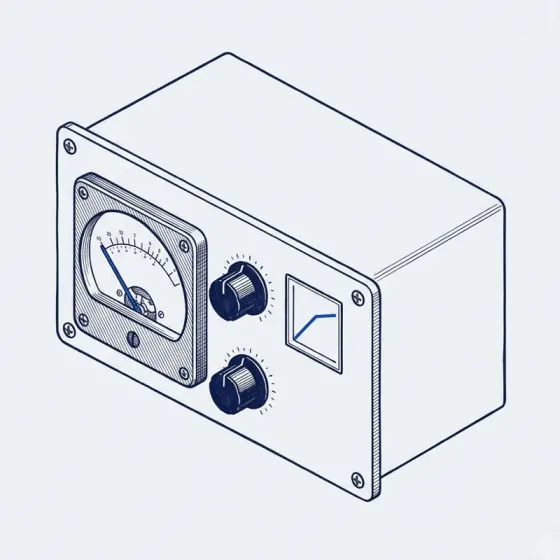
 Dynamic Processing8 lessons
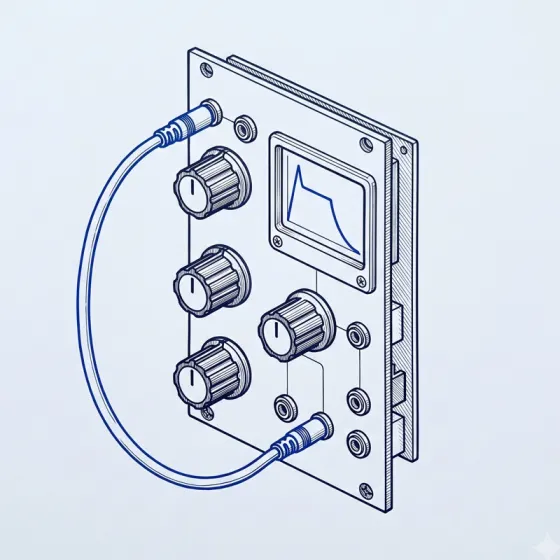 Synthesis4 lessons
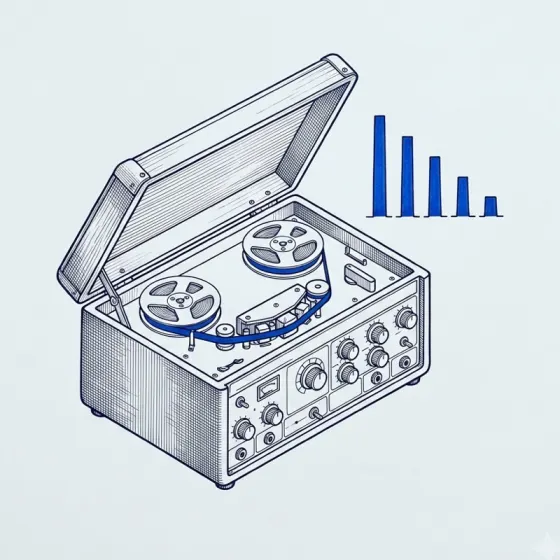 Delay Effects1 lesson
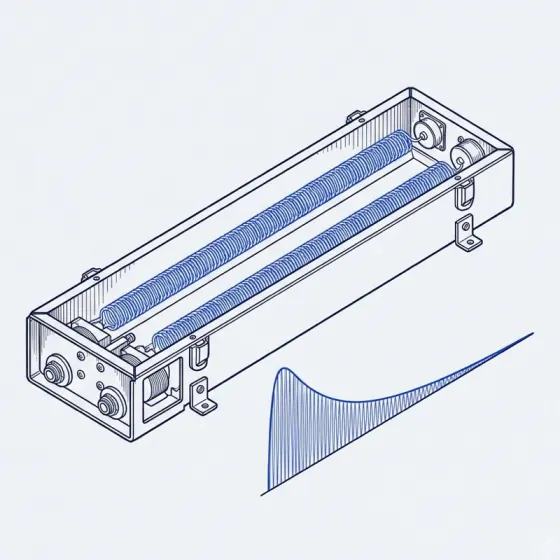 Reverb1 lesson
Each lesson teaches one idea on a drawing of the device, with the sound on. I take it apart, you try it, you copy a sound by ear, and you explain it back.
Run one with the class on the board, or set it for homework. Most take 15 to 25 minutes.
One block for each step, in the order the lesson runs:WatchTryMakeDescribeExplain
A compressor turns down what goes over its threshold, by its ratio. I take it apart on the input and output graph; then you level a vocal, keep a drum's punch and copy three sounds by ear, a limiter last.
Threshold, Ratio, Knee, Gain reduction, Attack, Release
See inside it: Fig 12, the compressor (free)
15 steps: Watch 9, Try 2, Make 3, Explain 1
A gate lets through what is loud and turns down what is quiet. On a vocal recorded in a room, with hiss, hum and a knock between the phrases; then you gate the vocal, a kick drum and whole words.
Threshold, Range, Attack, Hold, Release
14 steps: Watch 8, Try 2, Make 3, Explain 1
The kick and the bass fight at the bottom. With a sidechain, the compressor on the bass listens to the kick, so each kick turns the bass down and comes through. Then the club pump and the swell, by ear.
Sidechain, Threshold, Ratio, Attack, Release
14 steps: Watch 7, Try 2, Make 3, Describe 1, Explain 1
A gate usually listens to its own track. Keyed, it listens to another one, so the kick and snare open it. A rhythm of your own first, then the gated reverb of 1980s drums.
Key, Threshold, Release, Gated reverb
See inside it: Fig 13, the gated reverb
13 steps: Watch 6, Try 2, Make 3, Describe 1, Explain 1
When an 's' makes the top of a voice loud, a de-esser turns the voice down for that moment and leaves the sung notes alone. You hear what it listens to, then tame the esses without a lisp.
Frequency, Listen, Threshold, Ratio, Attack, Release
12 steps: Watch 6, Try 2, Make 2, Describe 1, Explain 1
A copy of the drums, squashed hard and mixed in under the untouched drums, lifts the quiet parts, the ghost notes, while the hits keep their punch. On a return track first, then with one Dry/Wet knob.
Return track, The blend, Dry/Wet
12 steps: Watch 6, Try 2, Make 2, Describe 1, Explain 1
Gate, expander, compressor and limiter as four shapes of the same line on one graph, heard on one vocal: which side of the threshold each one turns down, and by how much.
Gate, Expander, Compressor, Limiter
11 steps: Watch 6, Try 2, Make 2, Explain 1
Eighteen problems, heard or in words, all mixed up. I show how I choose, by asking when the problem is there; then you pick what fixes each one, and hear it fixed. Where the paper credits a second answer, you hear why the first is better.
Noise gate, Compressor, EQ, De-esser, Sidechain, Fix it at the recording
22 steps: Watch 2, then two rounds of 10
1.3
A course of four, in teaching order.
Same synth, same note, and one plucks while the other swells: only the envelope has changed. I take Attack, Decay, Sustain and Release apart on a graph of the level over time; then you finish my settings, copy sounds by ear and draw the shape.
Attack, Decay, Sustain, Release
14 steps: Watch 8, Try 2, Make 3, Explain 1
Sine, triangle, square, sawtooth and noise on the same note, each heard and seen with its harmonics before I ask about it; then frequency, the octave and the level.
Sine, Triangle, Square, Sawtooth, Noise, Octave
12 steps: Watch 7, Try 2, Make 2, Explain 1
Low-pass, high-pass and band-pass, the cutoff, the slope and resonance, each heard as it moves; then you draw them on the exam's grid.
Low-pass, High-pass, Band-pass, Cutoff, Slope, Resonance
11 steps: Watch 6, Try 2, Make 2, Explain 1
Two oscillators: the carrier you hear, and the modulator that bends it. The modulator's level sets the brightness, the ratio decides between in tune and a bell, and an envelope makes the brightness move.
Carrier, Modulator, Level, Ratio, Envelope
11 steps: Watch 6, Try 2, Make 2, Explain 1
What a delay does, one control at a time: time, feedback, wet and dry, the filter, ping-pong and tempo. Then one delay from each era, from slapback to the DAW.
Time, Feedback, Wet/Dry, Filter, Ping-pong, Tempo
See inside it: Fig 1, the tape echo
19 steps: Watch 12, Try 3, Make 2, Describe 1, Explain 1
Where is the tail made? Five reverb machines, one from each era, each drawn with the tail it makes. Silent on purpose: you hear the real sounds in Live, with the card at the end.
Watch, then Try, then the real sounds in Live
See inside it: Fig 4, the spring reverb tank
It is free: fourteen steps, about twenty-five minutes, in any browser. Put it on the board and press Start.