The machine that speaks for itself.

Each figure is a drawing of a real machine, from a studio that used it, and it works. Drag a knob and it does what the real one did. Point at a part and it names itself. Press Listen and hear it.

Fourteen so far, era by era, each one checked against the chapter a student reads.

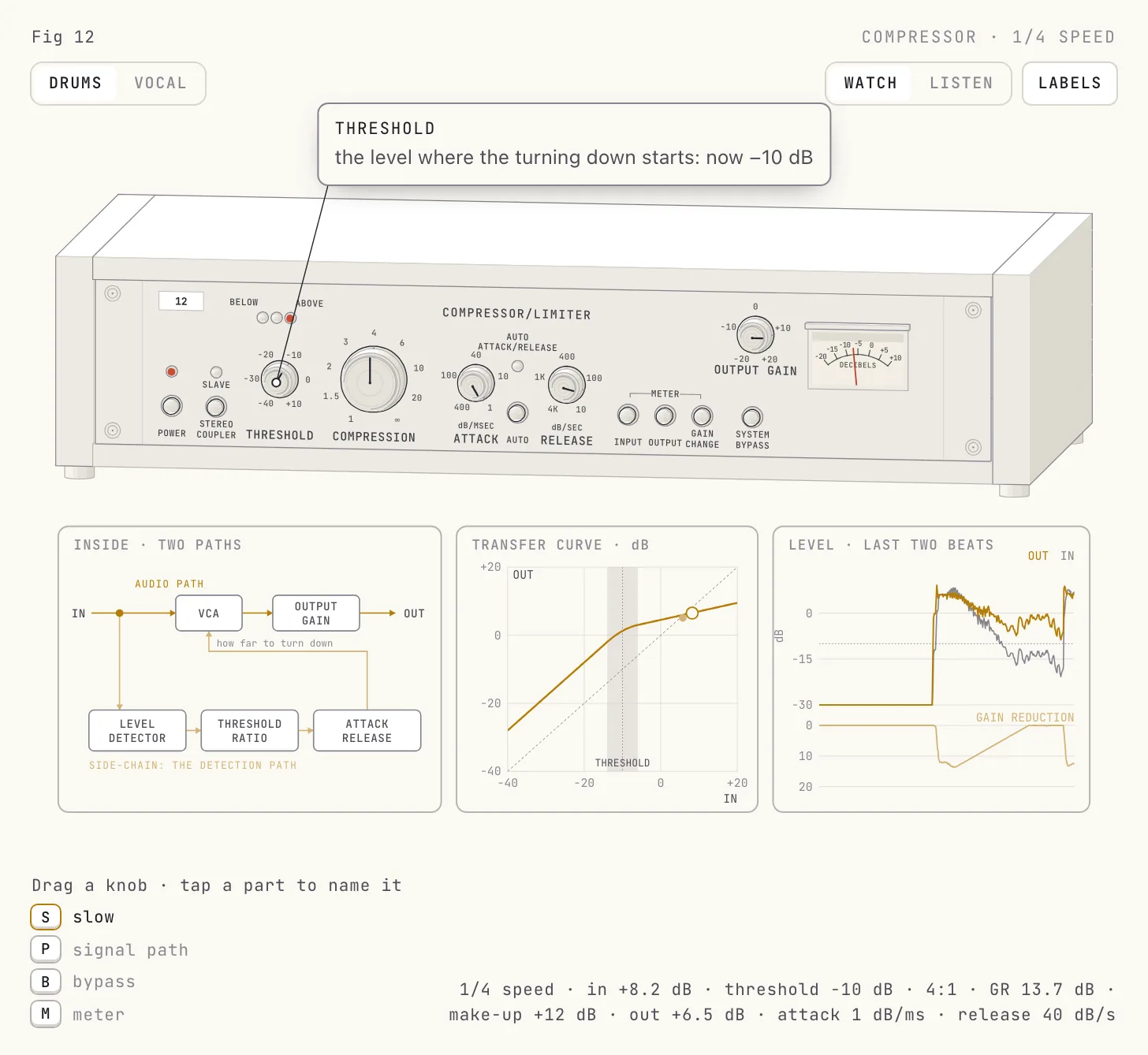
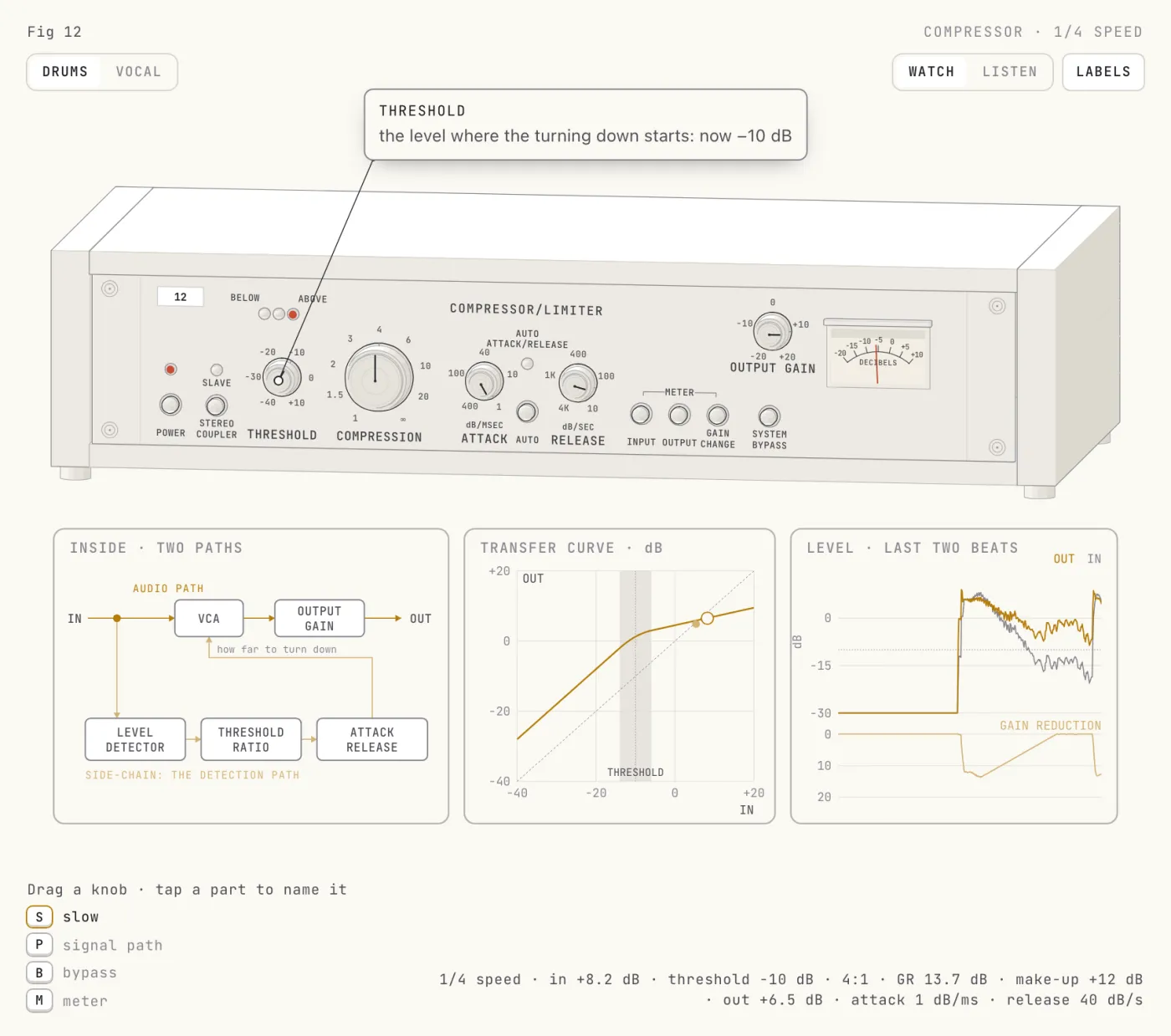
Fig 12, the compressor: a late-1970s compressor/limiter with threshold, ratio, attack, release and output gain, and below it the signal path inside, the transfer curve and the level over the last two beats

Fig 12, the compressor. The free figure: open it full size.

How a figure works.

Fig 12, the compressor, part by part. Every figure works the same way, so a class learns it once.

  1. Turn the controls

    Drag a knob and the machine does what the real one did. Turn the threshold down and the curve bends sooner, and the meter swings further.

  2. Point at any part

    It names itself and says what it does: the threshold is the level where the turning down starts.

  3. See inside it

    Panels beside the machine show what the real one hides: the path the signal takes, the transfer curve, and the level over the last two beats, moving as it plays.

  4. Watch, then Listen

    Watch slows the machine so the eye can keep up, here to a quarter of its speed. Listen plays it at true speed, on drums or a vocal.

  5. The true numbers

    The corner gives the real values as they change: the level in, the threshold, the ratio, how far it is turning down.

  6. Labels off

    Switch the names off, point at a part and ask the class what it is.

Fig 12, the compressor, with numbered points on the parts described
Fig 12 as it opens. Point at a number or a line to match them.

Every figure.

Era 1Direct to tape, mono

c.1930 to 1963. 4 figures.

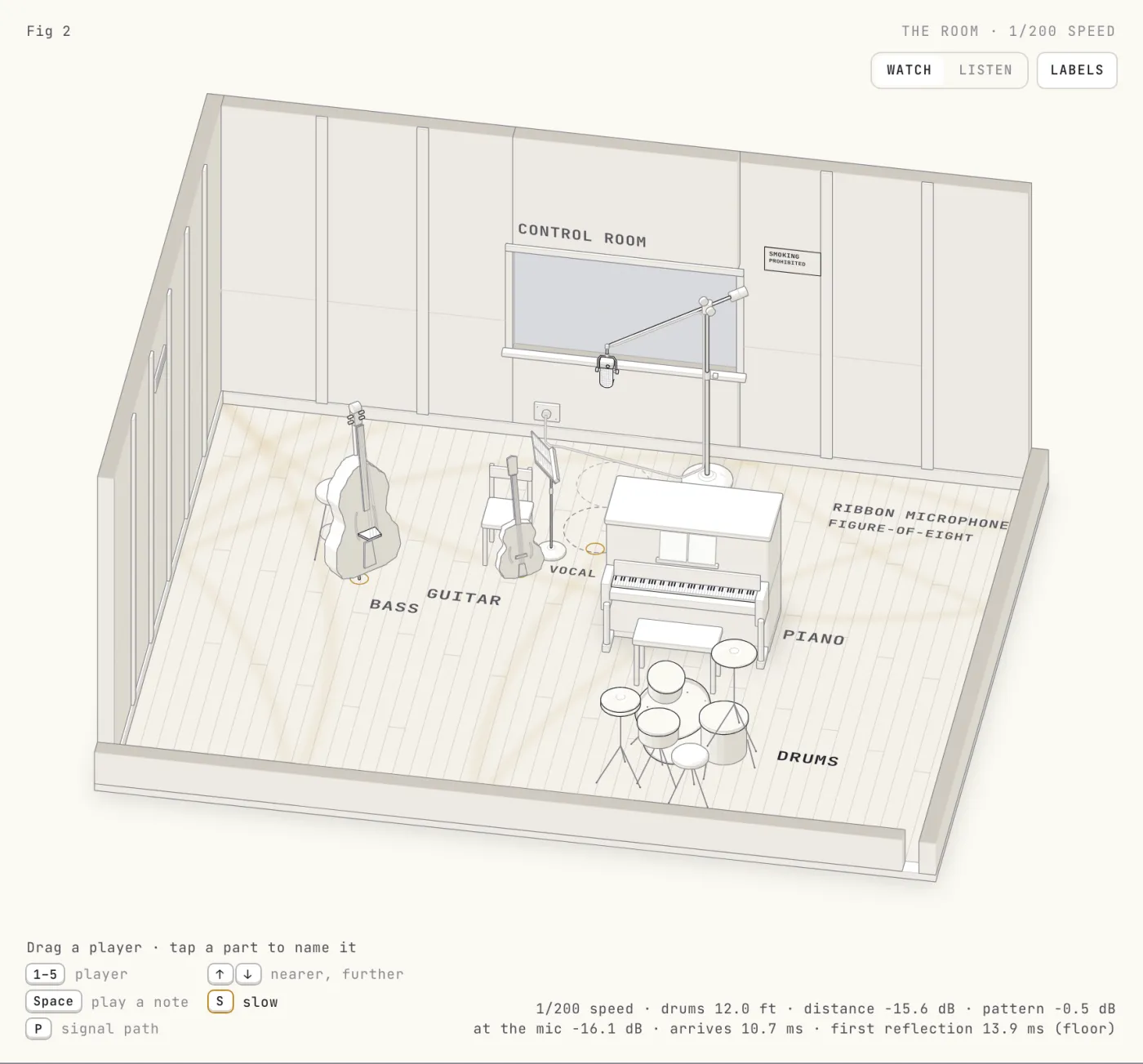
The room, Fig 2

A New York studio of 1946 with one ribbon microphone: the balance is where the players stand. Each note leaves as a wavefront at 1/200 of its true speed and reaches the microphone in order of distance. Drag a player and the readout splits the level into distance and the microphone's pattern. Press Listen to hear five stems through the room.

Watch
at 1/200 speed
Listen
at true speed
Labels
on, or off to quiz the class

Read about it in Recording & Microphones, Era 1: direct to tape, mono.
Open Fig 2, for members

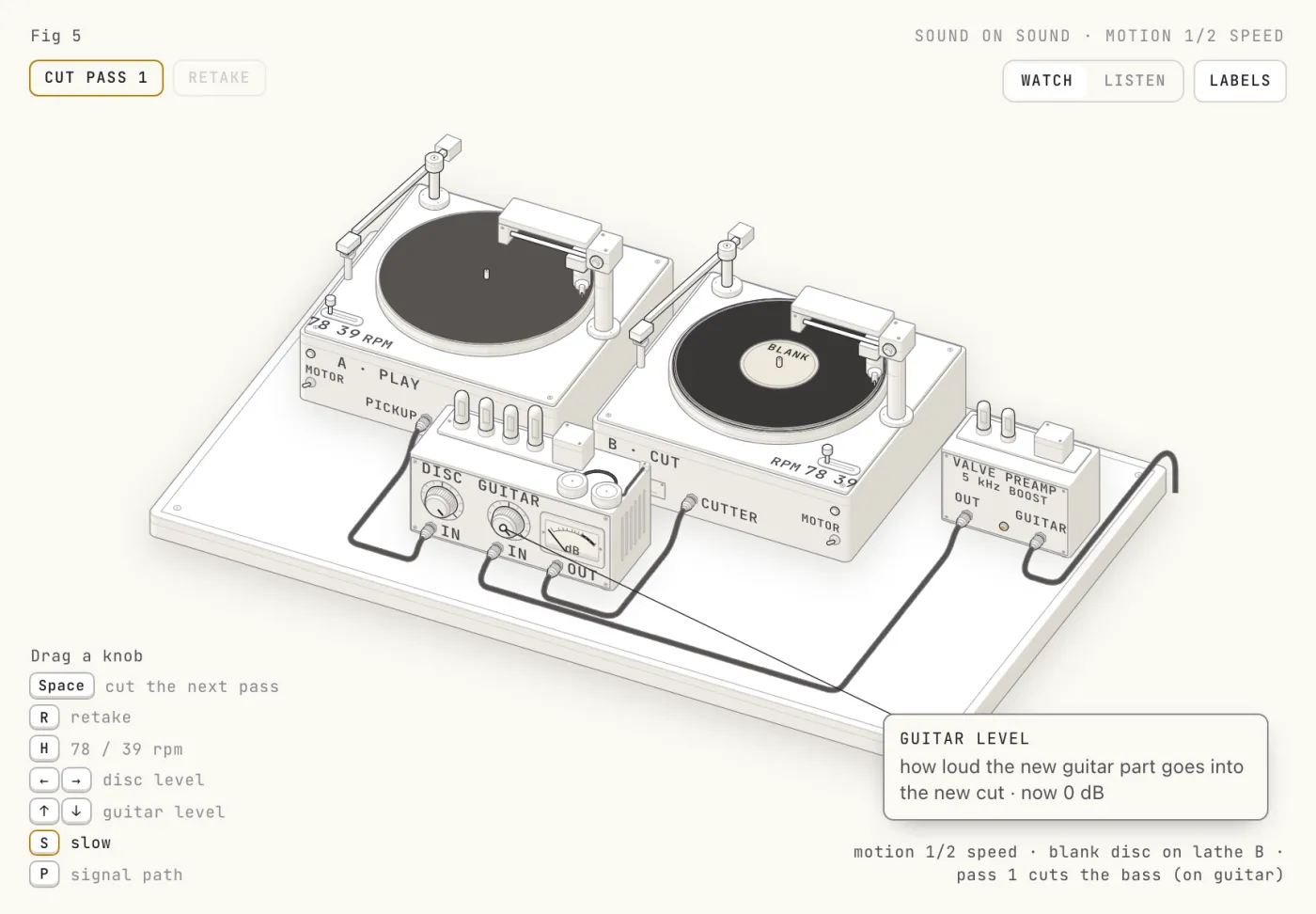
Sound on sound, Fig 5

One disc lathe plays the last disc while the other cuts a new one, with a new part added through the mixer. Every pass copies the old parts once more, so the hiss builds and a wrong balance can never be undone. Cut a pass at 39 rpm and it plays back an octave up.

Watch
at half speed
Listen
at true speed
Labels
on, or off to quiz the class

Read about it in Analogue Recording, Era 1: direct to tape, mono.

Open Fig 5, for members

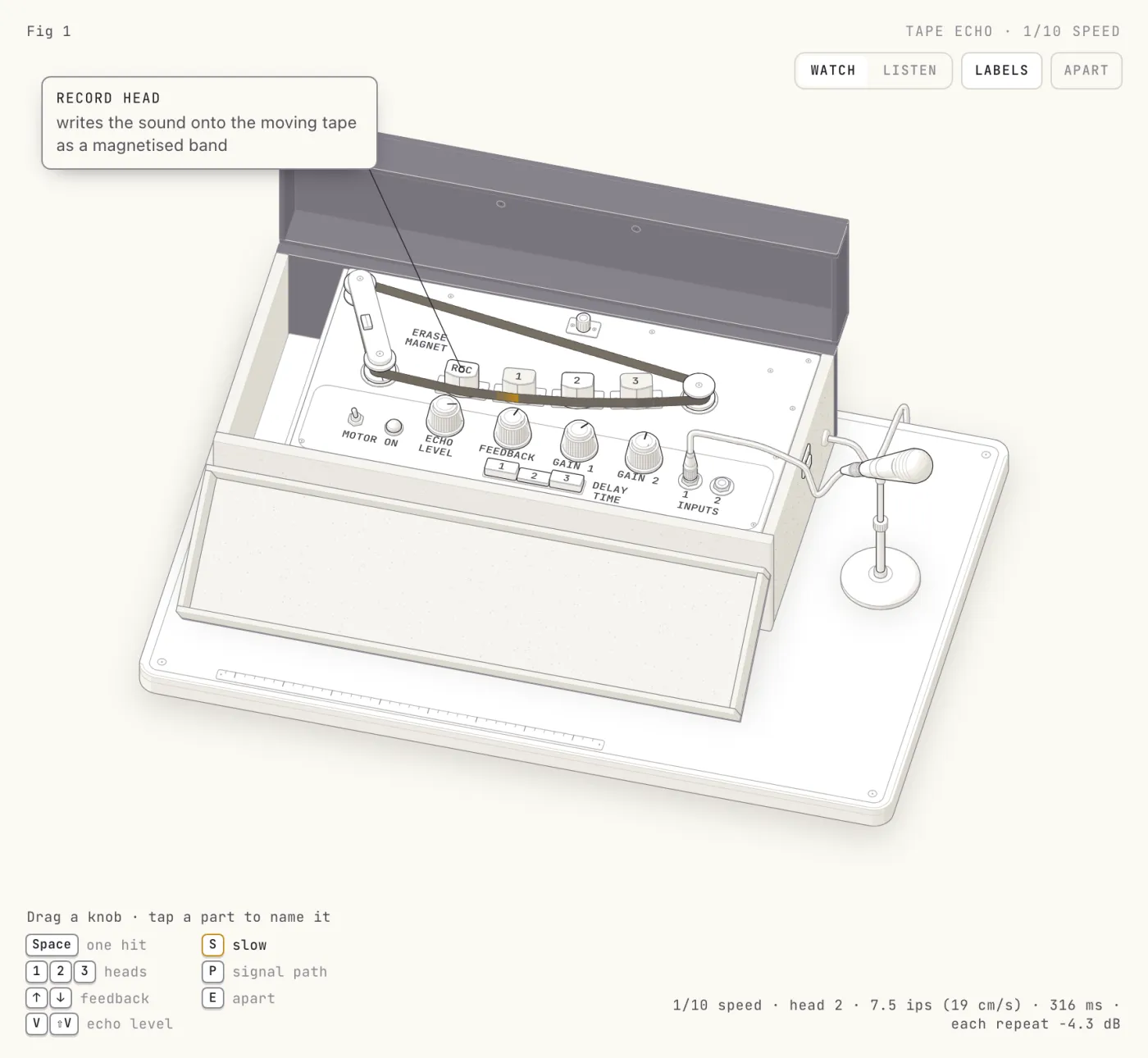
Tape echo, Fig 1

A fixed-head unit of the early 1960s in its cloth carry case: a loop of tape carries each sound past three playback heads, and a magnet on the tension arm wipes it before it comes round again. Delay time is the head's distance from the record head divided by the tape speed; feedback records each repeat again, quieter.

Watch
at 1/10 speed
Listen
at true speed
Labels
on, or off to quiz the class

Read about it in Delay Effects, Era 1: direct to tape, mono.
The lesson in the lab: Delay through the eras, from slapback to the DAW.

Open Fig 1, for members

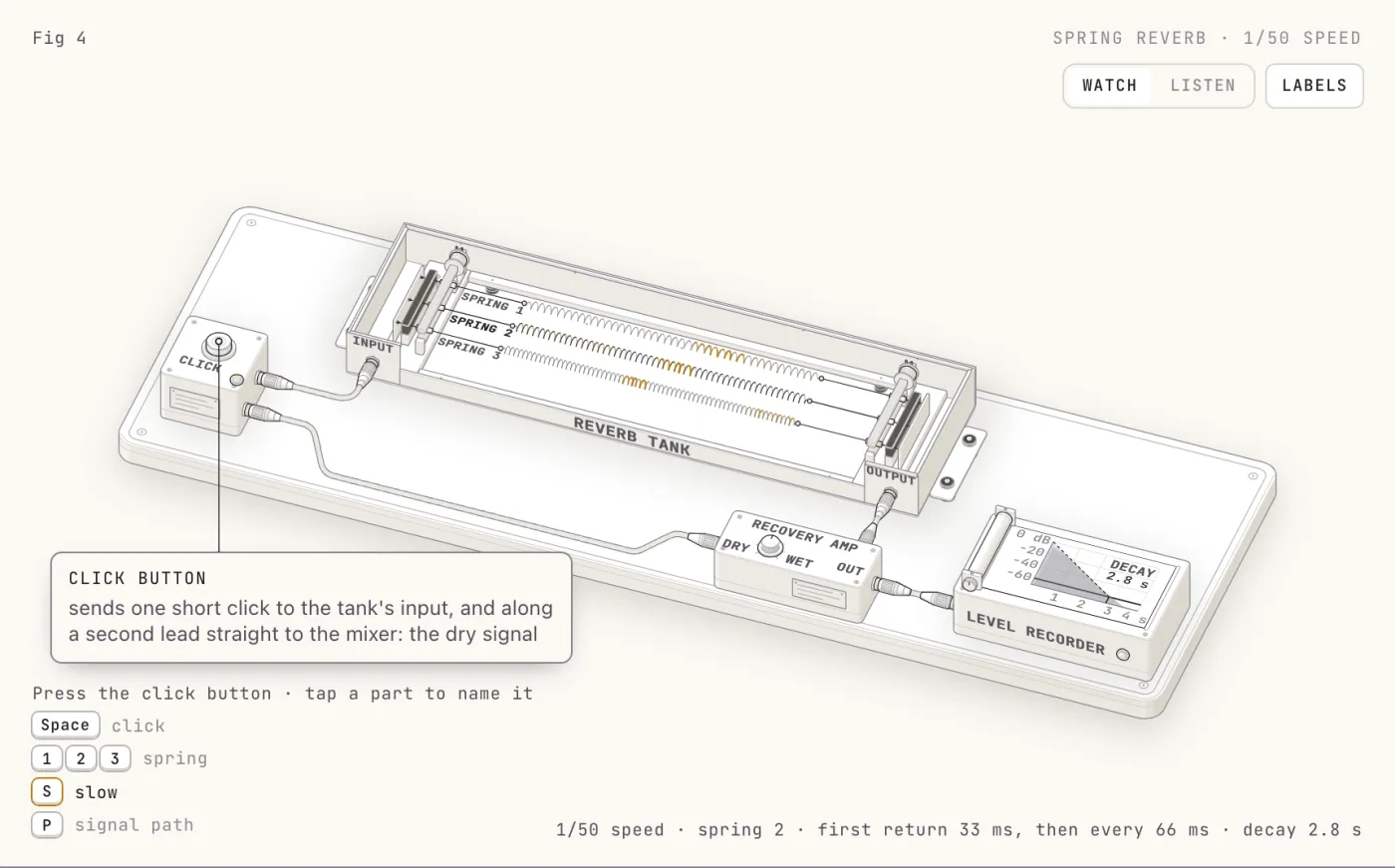
Spring reverb tank, Fig 4

A click runs along three springs, bounces between the ends and reaches the pickup a little weaker each time. The spring carries low frequencies faster than high ones, so every return arrives smeared into a chirp: the twang.

Watch
at 1/50 speed
Listen
at true speed
Labels
on, or off to quiz the class

Read about it in Reverb, Era 1: direct to tape, mono.
The lesson in the lab: Reverb through the eras, five machines, one from each era.

Open Fig 4, for members

Era 2Early multitrack

c.1964 to 1969. 4 figures.

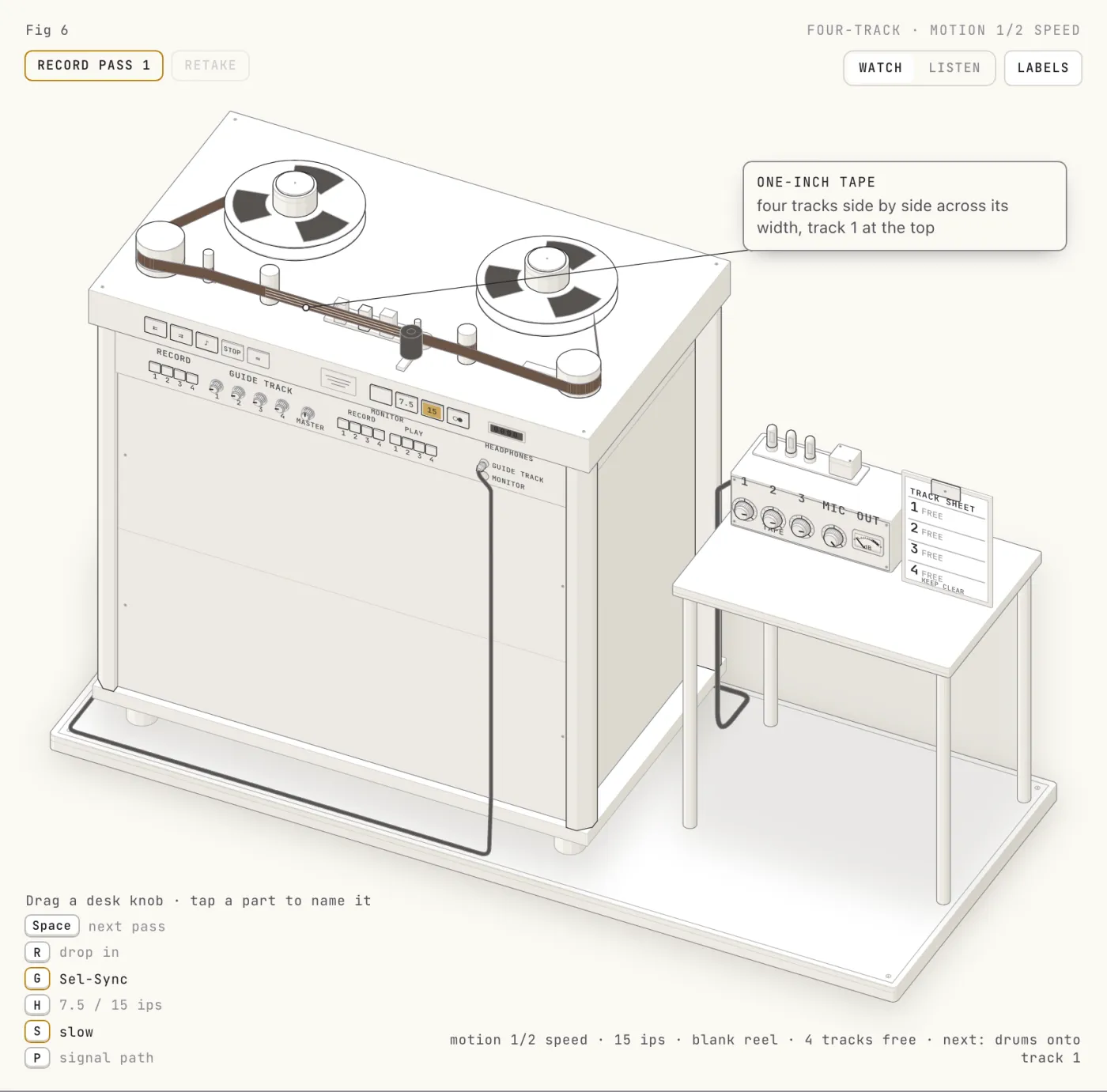
Four-track, Fig 6

The valve four-track a London studio bought in 1965. Six passes build a song track by track, then three tracks are bounced onto the fourth. Switch Sel-Sync off and the overdub lands 125 ms late, the head gap divided by the tape speed.

Watch
at half speed
Listen
at true speed
Labels
on, or off to quiz the class

Read about it in Analogue Recording, Era 2: early multitrack.

Open Fig 6, for members

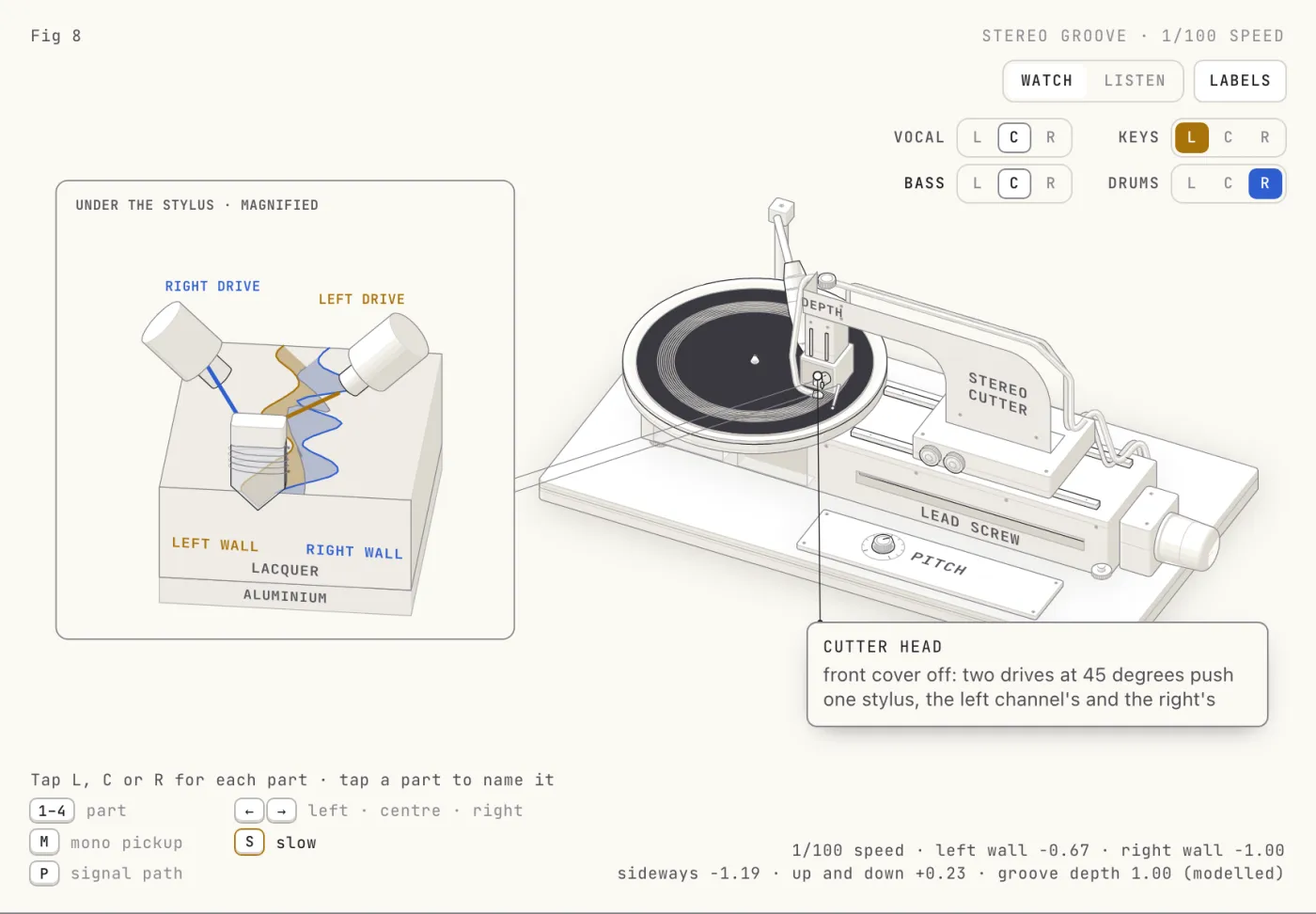
Stereo groove, Fig 8

A 1958 mastering lathe with its cutter head open, and the groove in section under the stylus: one channel on each wall, at 45 degrees. Put each part left, centre or right and watch the walls move; M plays what a mono pickup hears. Put the bass hard to one side and the stylus nears jumping the groove.

Watch
at 1/100 speed
Listen
at true speed
Labels
on, or off to quiz the class

Read about it in Stereo & Panning, Era 2: early multitrack.

Open Fig 8, for members

ADT and flanging, Fig 9

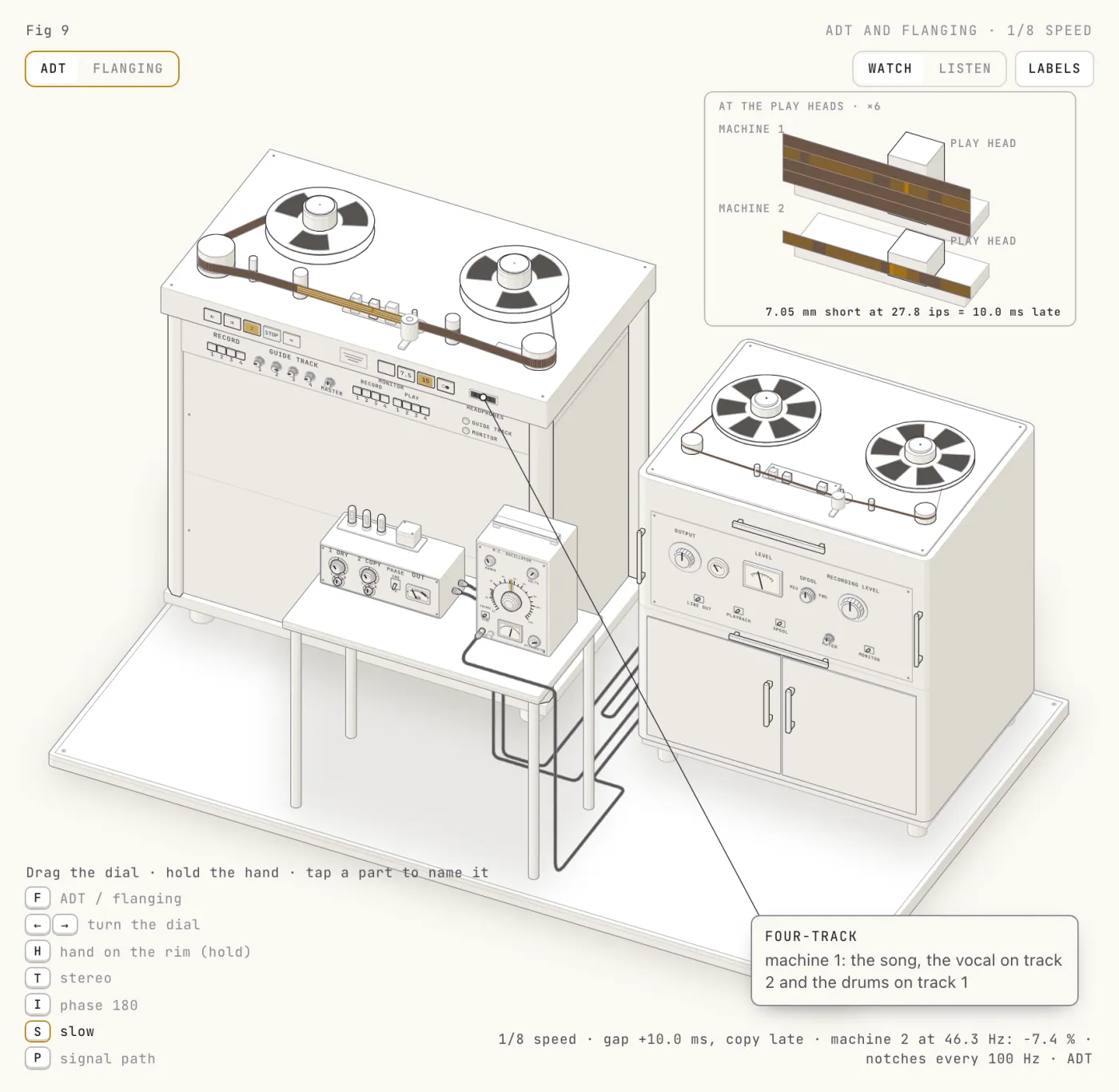
Two tape machines and one moving copy, as a London studio rigged them in 1966. ADT: an oscillator sets the second machine's speed, so its copy of the vocal returns about 10 ms late, nudged by hand. Flanging: both machines play the drums and a hand on one reel's rim drags the gap through zero.

Watch
at 1/8 speed
Listen
at true speed
Labels
on, or off to quiz the class

Read about it in Modulation & Voice FX, Era 2: early multitrack.

Open Fig 9, for members

Modular synthesiser, Fig 7

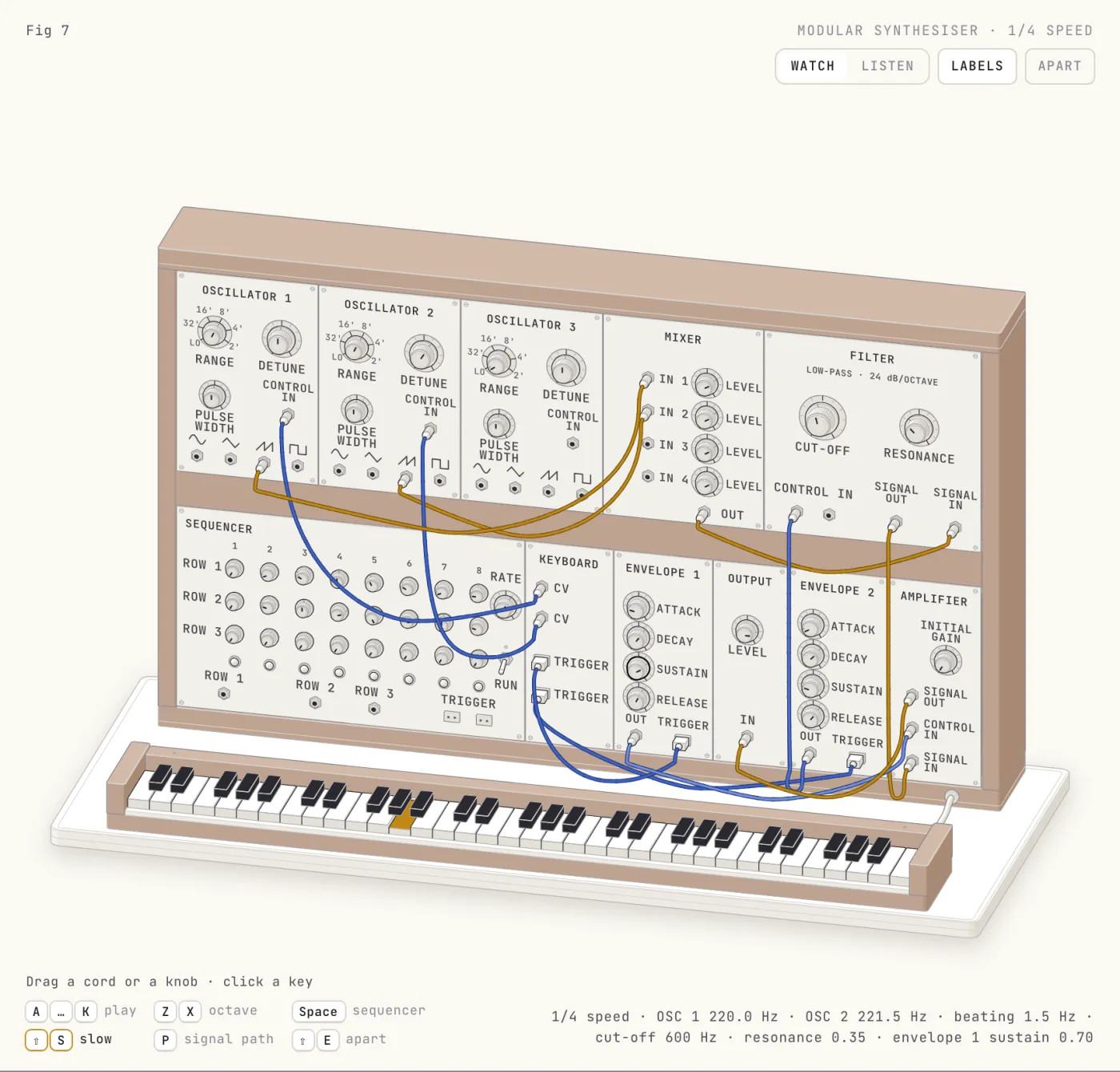
A modular synthesiser of 1968 makes its sound from voltages, and the patch cords decide where each one goes. Gold cords carry audio and blue cords carry control voltage: drag them to repatch, then play it from the keyboard or the sequencer.

Watch
at 1/4 speed
Listen
at true speed
Labels
on, or off to quiz the class

Read about it in Synthesis, Era 2: early multitrack.

The course in the lab: Synthesis, from the envelope to FM.

Open Fig 7, for members

Era 3Large-scale analogue multitrack

c.1969 to 1995. 6 figures.

24-track and noise reduction, Fig 11

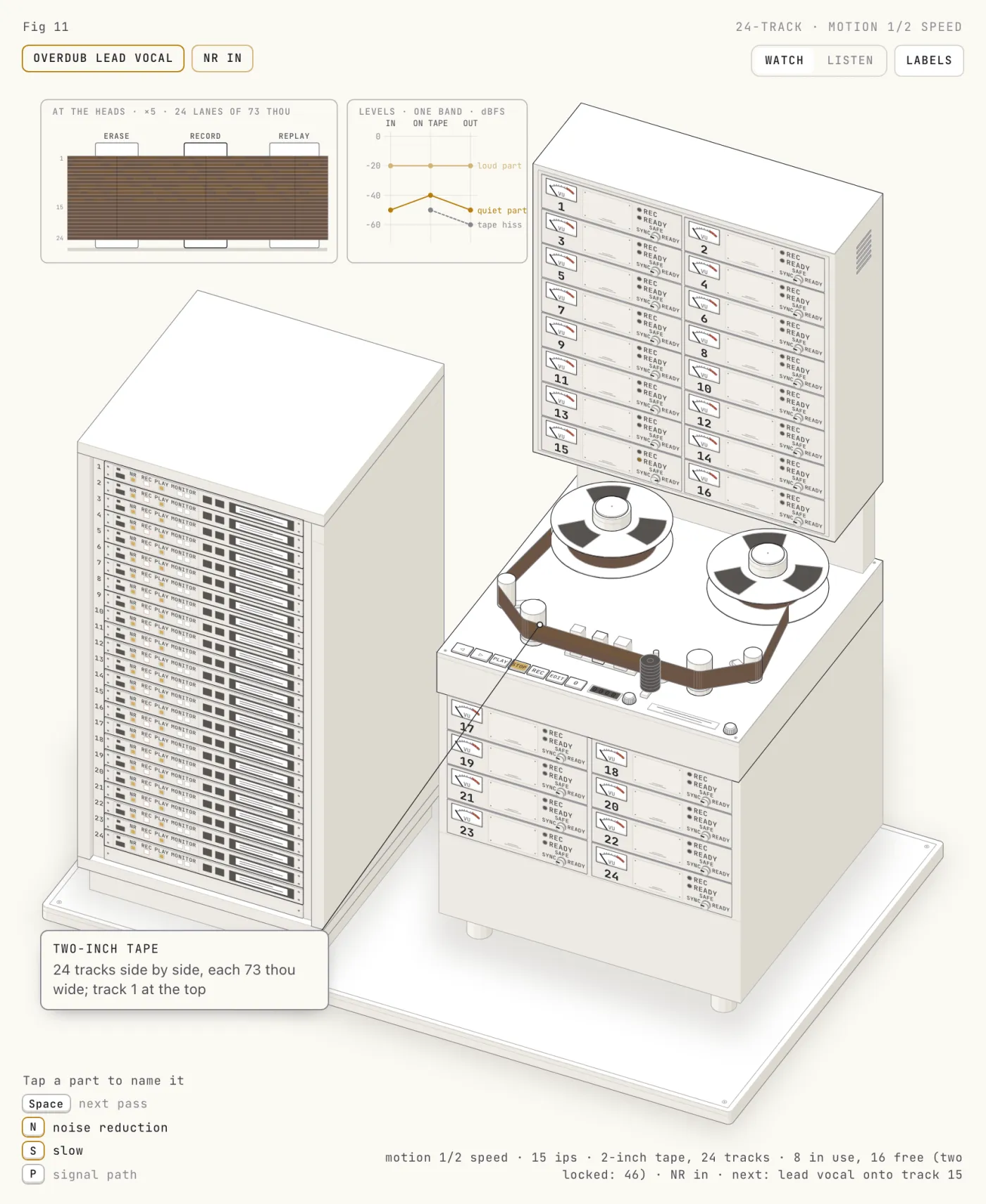
Twenty-four tracks on two-inch tape, a 1970s studio machine at the four-track's scale, with a rack of noise-reduction units beside it, one a track. Space overdubs the lead vocal onto track 15 while the other tracks play in sync. N switches the noise reduction: quiet parts go onto the tape 10 dB up and come off 10 dB down, and the hiss goes down with them.

Watch
at half speed
Listen
at true speed
Labels
on, or off to quiz the class

Read about it in Analogue Recording.

Open Fig 11, for members

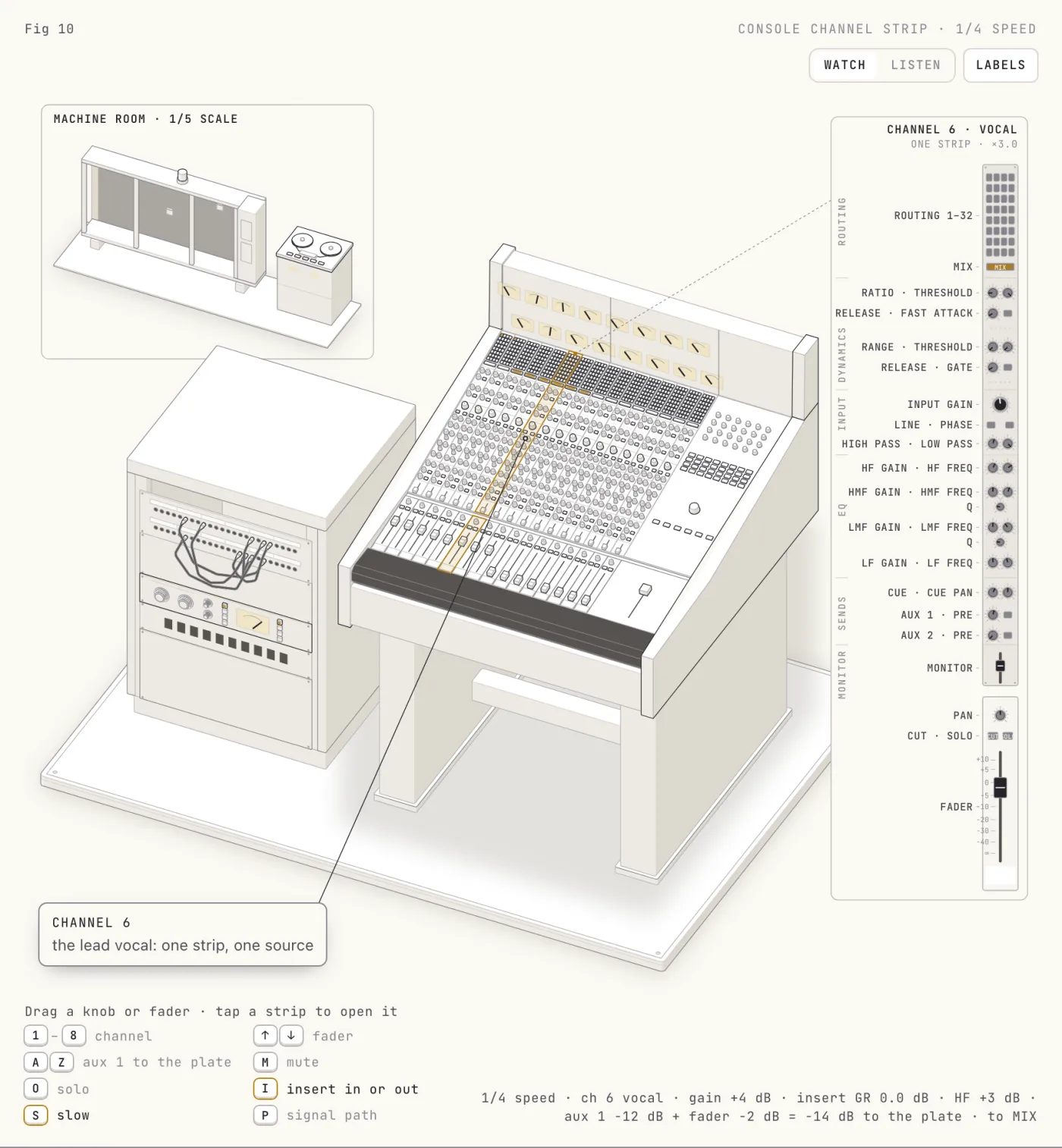
Console channel strip, Fig 10

A large console of 1979 on: sixteen identical strips, each with its own compressor and gate, a patchbay and an outboard limiter in the rack, a plate and a two-track in the machine room. Six stems run through the strips. I puts the limiter in the vocal's insert, A and Z send it to the plate, and the drums ride on one subgroup fader.

Watch
at 1/4 speed
Listen
at true speed
Labels
on, or off to quiz the class

Read about it in Signals & Connections.

Open Fig 10, for members

Compressor, Fig 12

A voltage-controlled compressor of the late 1970s with threshold, ratio, attack, release and output gain on its panel and a meter for the gain change. Inside, a level detector tells the VCA how far to turn down; the transfer curve and a trace of the last two beats move as you turn the knobs. Drums or vocal.

Watch
at 1/4 speed
Listen
at true speed
Labels
on, or off to quiz the class

Read about it in Dynamic Processing.

The lesson in the lab: The compressor in Live, where you set one by ear.

Open Fig 12, free

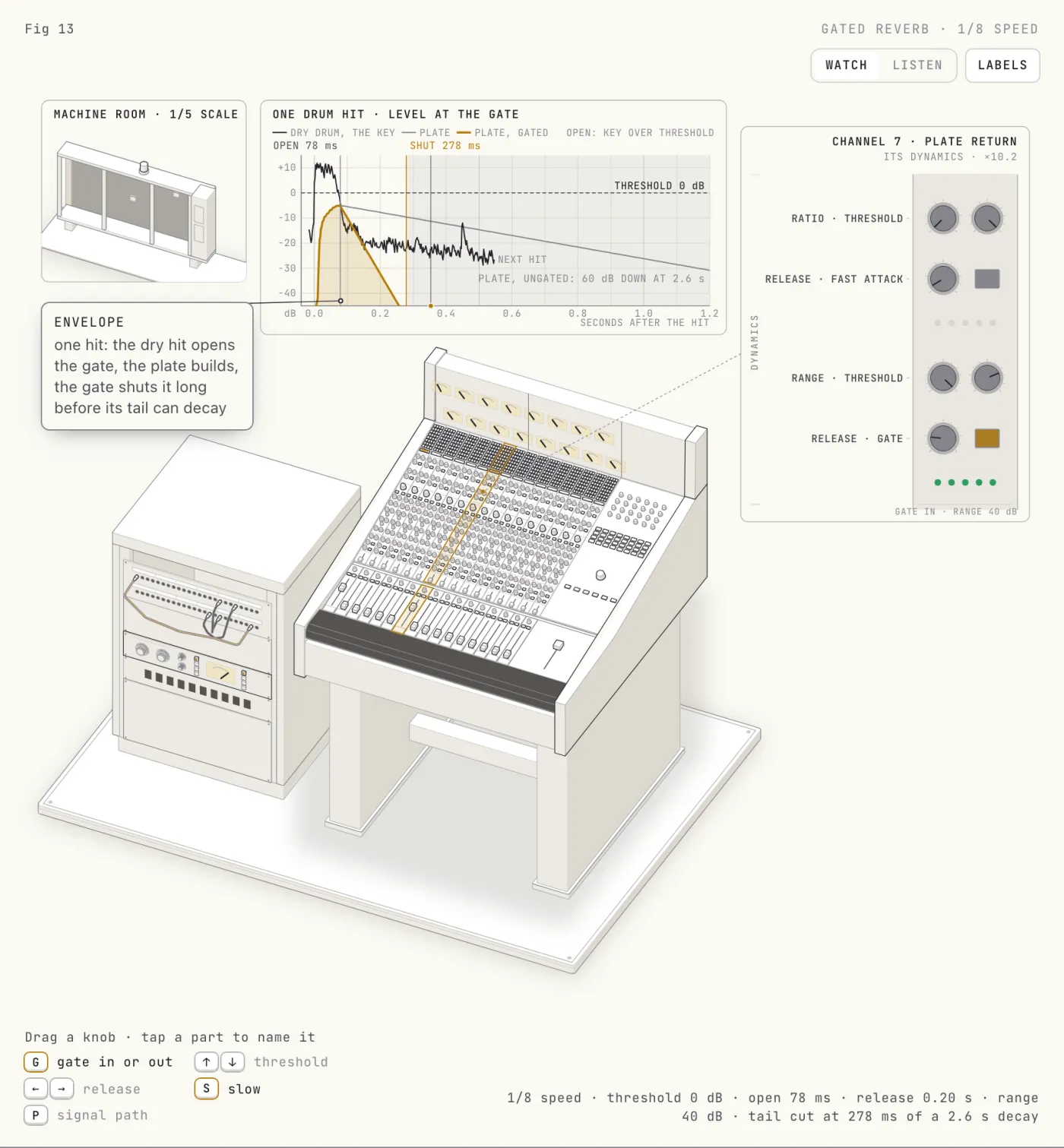
Gated reverb, Fig 13

Fig 10's console with the drums sent to the plate and the plate's return through its own channel's gate. A patch cord from the drum channel keys that gate, so each hit opens it, the plate builds, and the gate shuts long before the 2.6 s tail can decay. Threshold and release move where the tail is cut.

Watch
at 1/8 speed
Listen
at true speed
Labels
on, or off to quiz the class

Read about it in Reverb, Dynamic Processing.

The lesson in the lab: The keyed gate, ending on the gated reverb of 1980s drums.

Open Fig 13, for members

Mix automation, Fig 14

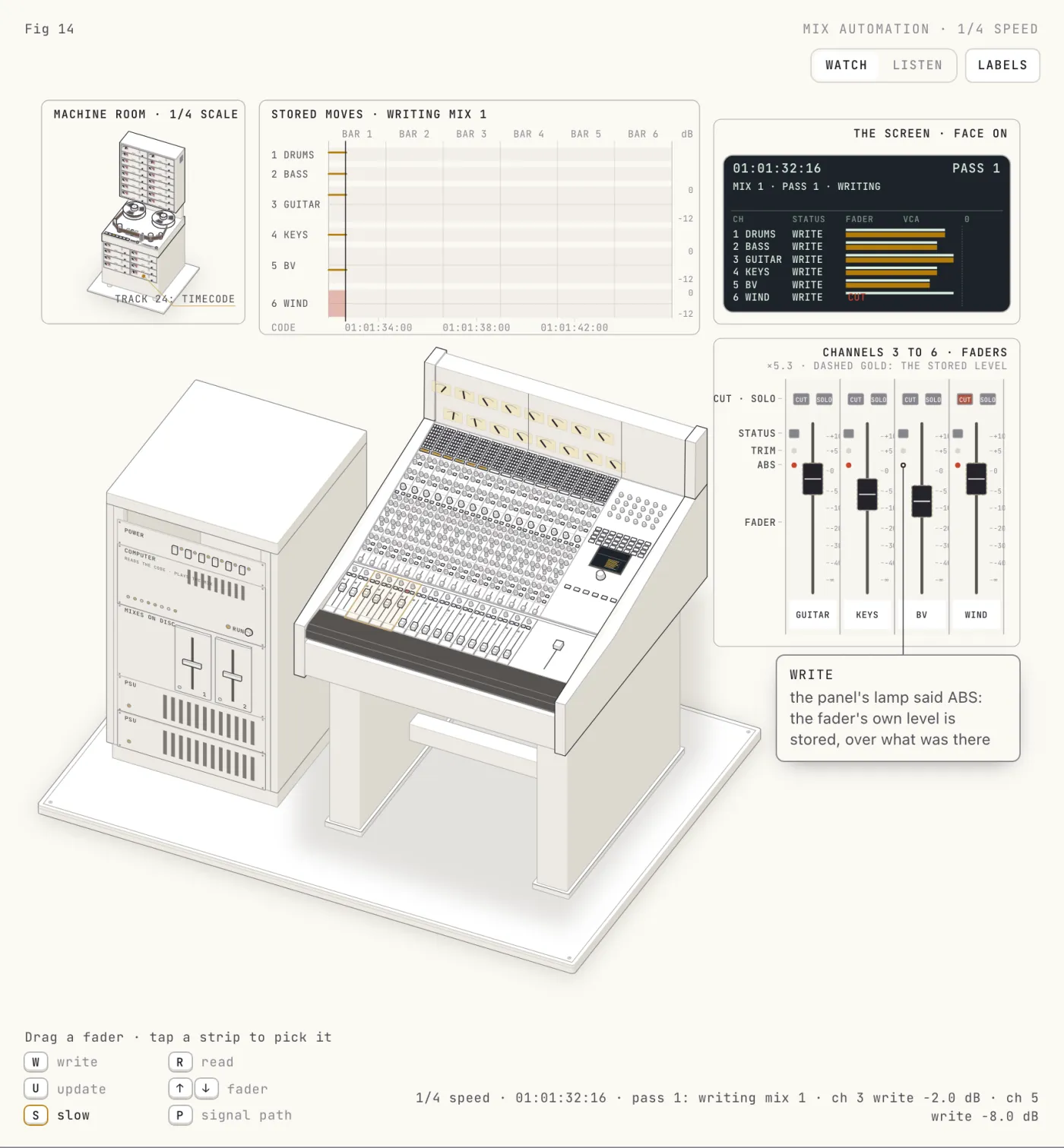
Fig 10's console with its own computer of 1979: it reads the timecode off the 24-track and sets each channel's VCA from fader levels and cuts stored on disc. Pass 1 writes the mix by hand, pass 2 replays it with the faders standing still, pass 3 trims the backing vocal while the rest replay. The mix is now a document.

Watch
at 1/4 speed
Listen
at true speed
Labels
on, or off to quiz the class

Read about it in Automation.

Open Fig 14, for members

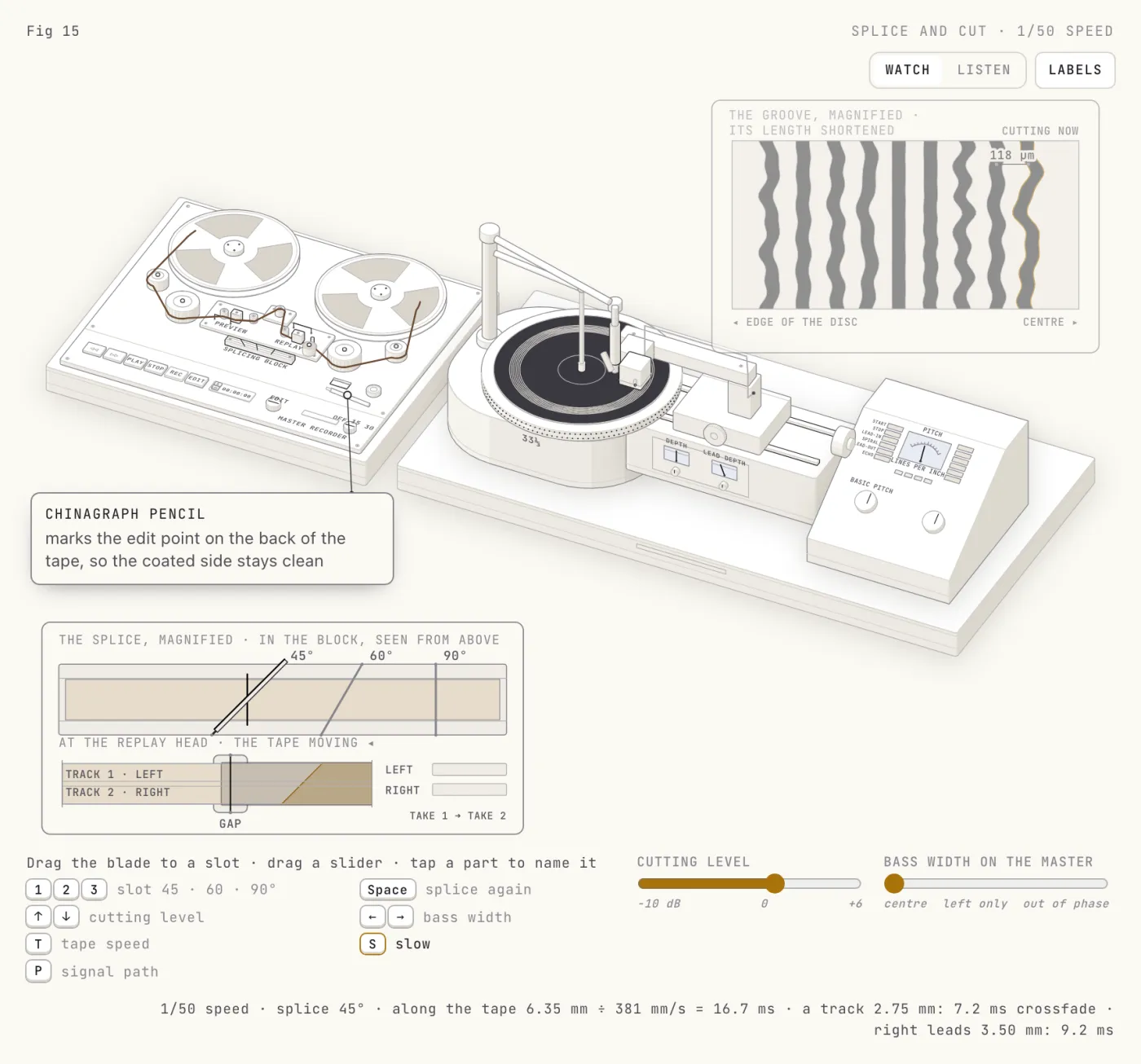
Splice and cut, Fig 15

The stereo master on a two-track mastering machine, with an editing block cut at 45, 60 or 90 degrees. A slanted join crossfades each track over a few milliseconds; a square one switches at once and clicks. The preview head lets a 1970 lathe space the groove ahead of the music, so a louder cut gives a shorter side.

Watch
at 1/50 speed
Listen
at true speed
Labels
on, or off to quiz the class

Read about it in Mastering.

Open Fig 15, for members

Era 4Digital recording and sequencing

c.1980 to now. Coming.

Digital multitrack, MIDI sequencing and the sampler are next.

Era 5The DAW and emerging technologies

c.1996 to now. Coming.

The DAW follows Era 4.

Put Fig 12 on the board.

Switch the labels off, point at a part and ask the class what it does. Then press Listen. Members get every figure, and the school licence gives them to every student.